 Spotify
 iVoox
iVoox Amazon
Earth | Tree and the Architecture of Atmosphere
Who Is Kengo Kuma? A Material-Driven Architectural Philosophy
Kengo Kuma stands as one of the most influential voices in contemporary architecture, not because of formal innovation alone, but due to a radical rethinking of how buildings relate to material, light, and human perception.
Emerging in Japan during a period still dominated by concrete modernism, Kuma deliberately positioned his work against the heavy, monumental language of the late twentieth century. Where earlier generations pursued permanence and visual power, his architecture seeks dissolution—an approach he has often described as “anti-object.” Buildings, in his view, should not stand apart from their context but instead blend into it, almost to the point of disappearance.
This philosophy is not abstract. It is grounded in material decisions. Wood replaces concrete, permeability replaces enclosure, and atmosphere replaces form as the primary driver of design. Across his work—from large-scale cultural buildings to small installations—there is a consistent effort to reduce architecture to a set of relationships between light, matter, and the body.
Kengo Kuma at Copenhagen Contemporary: Understanding Earth | Tree
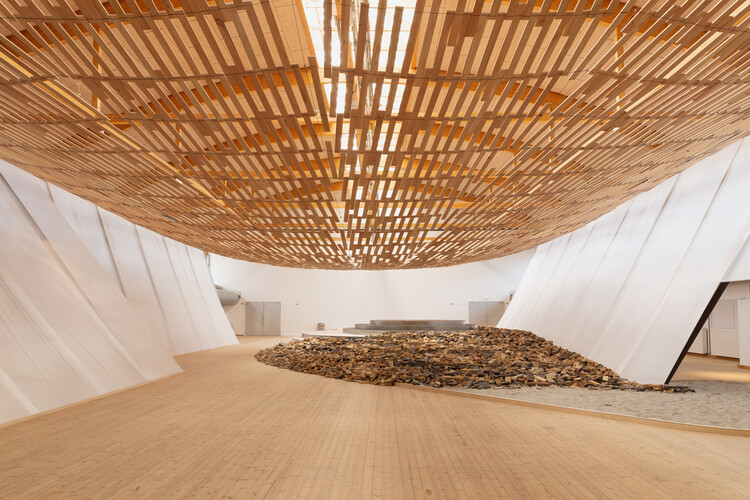
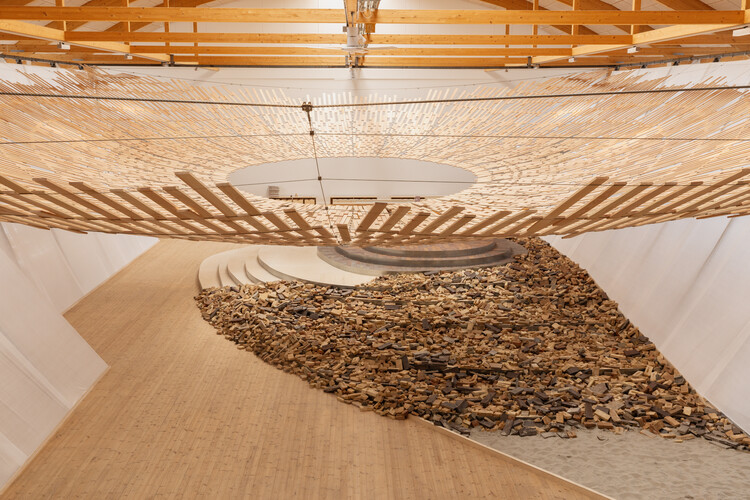
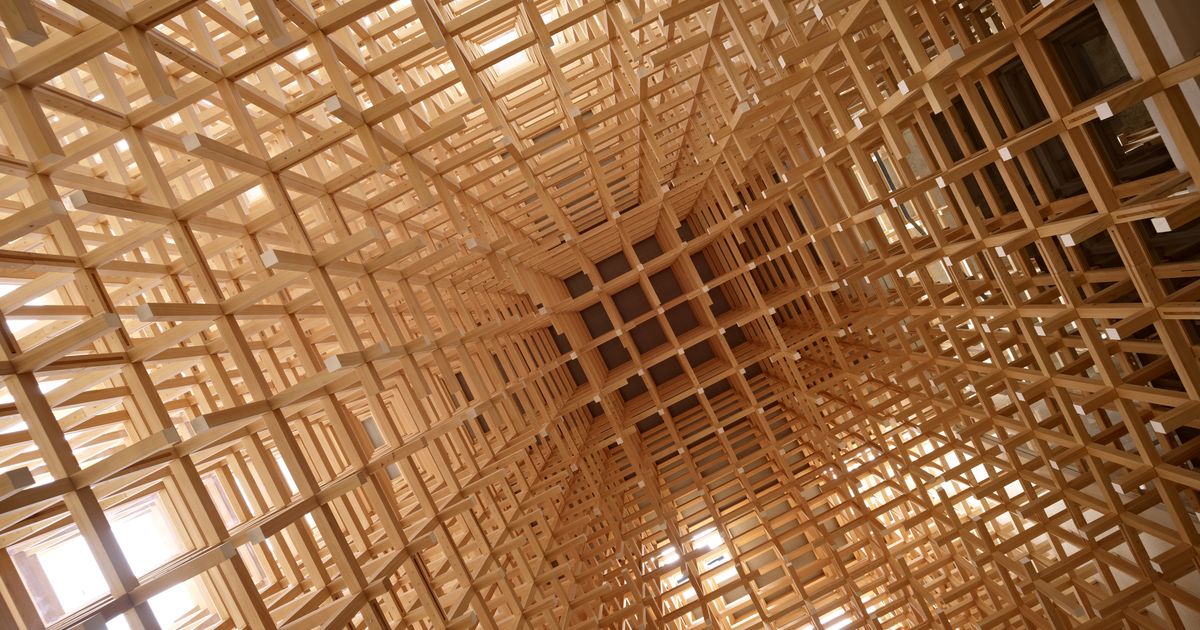
At Copenhagen Contemporary, this philosophy takes on a distilled form in Earth | Tree, a site-specific installation developed by Kengo Kuma & Associates. Installed within a former industrial hall, the project transforms a large, neutral volume into a carefully calibrated spatial environment defined by timber, brick, and filtered light.
The central element is a suspended wooden structure composed of finely crafted Douglas fir components. Rather than acting as a conventional architectural element, it operates as a filter—modulating light as it enters the space and projecting a constantly shifting pattern onto the surfaces below. The experience changes throughout the day, reinforcing the idea that architecture is not static but temporal.
What becomes immediately evident when moving through the installation is that it is not designed as an object to be observed. It is conceived as a condition to inhabit. The boundaries between structure, atmosphere, and perception are intentionally blurred, aligning with Kuma’s long-standing ambition to create spaces that are felt before they are understood.
Komorebi and the Construction of Atmosphere
At the conceptual core of Earth | Tree lies the Japanese notion of komorebi, a term that describes the subtle phenomenon of sunlight passing through the leaves of trees. While often referenced poetically, here it is translated into a precise spatial mechanism.
The timber structure functions as a porous canopy, allowing light to penetrate in fragments rather than as a uniform field. This fragmentation produces depth without relying on mass, and enclosure without solid boundaries. The result is an environment where light assumes a structural role, organizing space as effectively as any physical element.
For architects, this is particularly relevant. It suggests a shift away from composition based on solid and void toward a more nuanced approach in which environmental factors—light, air, and time—become primary design tools.
Wood and Brick: Between Japanese and Nordic Traditions


Material selection in Earth | Tree is both restrained and deliberate. The use of Douglas fir timber is paired with brick elements from Petersen Tegl, establishing a dialogue between Japanese and Nordic construction traditions.
Timber introduces lightness and sensory richness, while brick provides weight and continuity. Together, they create a layered spatial experience where materials are not finishes, but active agents shaping perception.
A Multi-Sensory Approach to Architecture
One of the defining qualities of the installation is its insistence on engaging more than just vision. The scent of timber, the tactile resistance of brick, and the subtle acoustic qualities of the space contribute to an environment that is perceived holistically.
This approach reflects a broader shift in architectural thinking toward embodied experience, where space is understood through movement, time, and physical interaction rather than image alone.
From Installation to Architectural Thinking
Although Earth | Tree exists as a temporary installation, it encapsulates many of the principles that define Kengo Kuma’s broader work. It demonstrates how architecture can be reduced to essential elements without losing depth or meaning.
Rather than adding complexity, the project refines the relationship between material, light, and human perception—offering a clear lesson for contemporary practice.
Kengo Kuma’s Expanding Presence in Denmark
The installation is part of a broader trajectory that sees Kengo Kuma’s work increasingly embedded in Denmark, including the H.C. Andersen House and the upcoming Water Culture House in Copenhagen.
In this context, Earth | Tree acts as both an exhibition and a statement—demonstrating how architecture can operate through atmosphere, material precision, and cultural dialogue.